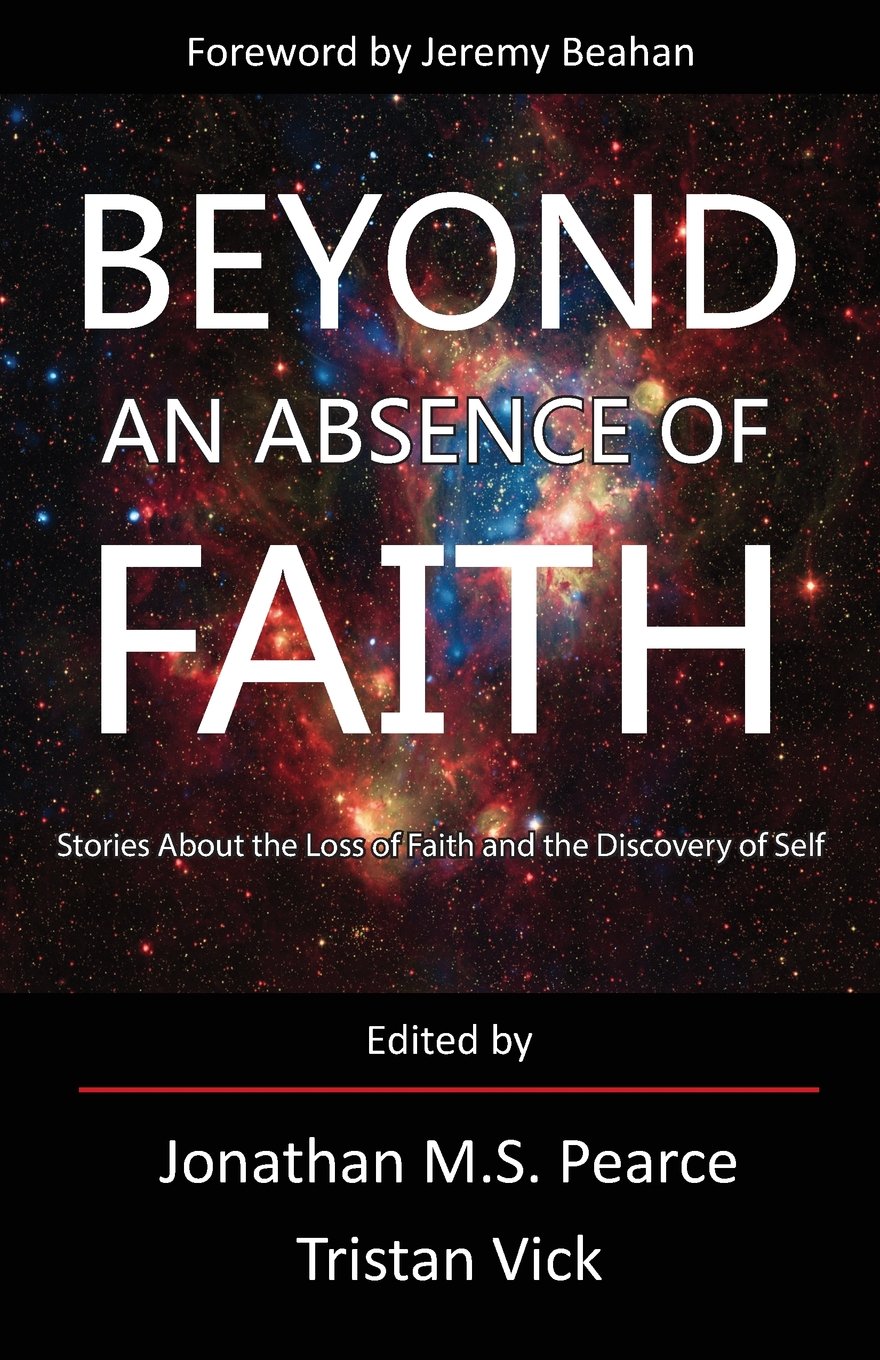
So there's this book that was just released that I'm particularly excited about - Beyond an Absence of Faith It's a collection of stories about people who've left religion and the impacts that has had on their lives. It was edited by Jonathan MS Pearce and Tristan Vick, which I can tell you is a good sign of the quality! It's even got a foreword by Jeremy Beahan of the Reasonable Doubts podcast, which is awesome considering how much that specific podcast helped me reground myself after deconverting.
So why am I excited about it? Because Johno asked me to contribute my own deconversion story to the book! I'm published in a book (though still using my pseudonym), which is something I never thought would happen. The version here is similar to my video/post on the matter, but with a bit more detail on my life before apostasy and on some personal aspects of the fallout that happened after.
What's better is that there are 15 other stories in the book, including ones by other online atheists I admire like Vyckie Garrison who escaped the Quiverfull Movement. It includes stories of apostates of different religions, and all of the stories here are honestly moving. It's frankly amazing what some people have gone through on their journey to apostasy. The book is less about arguing for atheism than it is about our respective journeys out of religion and finding ourselves again.
Kaveh Mousavi at On the Margin of Error wrote a very nice review of the book, and so far the reviews on Amazon have been quite kind as well. I'm a bit biased, but I highly recommend picking up a copy. It's in paperback and on Kindle.
Showing posts with label Quiverfull. Show all posts
Monday, May 19, 2014
Monday, October 7, 2013
The Quiverfull movement and Skeptical Theism
The latest Reasonable Doubts series with Vyckie Garrison (who blogs at No Longer Quivering) is really compelling because her
story is so painful, but because things seem to have worked out well in the end
for her and her children.
Her interview in RD Episode 119 where she started talking
about “spiritual abuse” it struck me as being related to a counter-apologetic
argument – the idea that skeptical theism leads to moral paralysis.
This seems to be a very real instantiation of that argument
playing out in real life, much to the detriment of Vyckie and other women like
her in the Quiverfull movement.
For those that don’t know Skeptical Theism is the idea that
humans have such a large chasm of knowledge between themselves and the mind of
an infinite god that they should not expect to know what reasons god has to permit
evils to obtain some greater good.
The argument is that such a view would lead to moral
paralysis because on this view, we don’t know whether or not any given evil
that we seemingly come across is being used by god to fulfill a greater good. So if we were to come across an instance of evil (like say a mugging), we wouldn't know whether or not to intervene or otherwise act on our moral intuitions because the mugging may be part of gods greater plan.
This relates directly to Vyckie’s account of “spiritual
abuse” where she internalizes the problems with her marriage and the problems
with her children that came about as a result of following what she thought was
“god’s plan” for the family. When she
speaks about recognizing opportunities to object to or escape the Quiverful
doctrine she wouldn’t do so, because she would think “what if god needs me here
to intervene in the life of my husband/child/etc.”
It seems to be a terrible real life instantiation of the
epistemic problems that would plague someone who took the skeptical theist
answer to the problem of evil seriously and consistently. I think this is significant because the kinds
of problems that pop up in the Quiverfull movement would probably be
acknowledged as problems by more progressive or moderate Evangelical Christians. The issue for them is they would then have to
deal with the epistemic problem that arises from the skeptical theism view that
the people in the Quiverfull movement take so seriously.
I’d even start to wonder if people in the Quiverfull
movement go to such extreme lengths because they take the epistemic issues
brought up by their views on the bible so seriously.
Subscribe to:
Posts (Atom)
